17 Oct 2018
TM gets prepared ahead of the upcoming monsoon season with swift water safety and humanitarian response training

Training to Upskill TM Volunteers and GDRN Members Towards Disaster Preparedness
Telekom Malaysia Berhad (TM) under its Corporate Responsibility (CR) initiatives once again provides a humanitarian response training for the Company’s volunteers as well as to members of the GLC Disaster Response Network (GDRN) ahead of the upcoming monsoon season. The Company recently organised the training session, titled “GDRN Swift Water Safety and Humanitarian Response” as part of its initiatives for disaster preparedness in Malaysia.
The four-day training – which featured certified trainers and speakers from the National Disaster Management Agency (NADMA), Ministry of Defense and United Nations Humanitarian Response Depot (UNHRD) – was aimed at strengthening the participants’ humanitarian capabilities and minimising the loss of life and damage to properties and the environment during a disaster. The session saw participation of over 30 participants from TM, GDRN members from Axiata Berhad, Pharmaniaga, Malaysia Airport Holding Berhad (MAHB), Yayasan Hasanah and Yayasan Sime Darby. In addition, more than 30 volunteers from Volunteer Malaysia (VM) - formerly known as iM4U - also took part in the simulation exercise, under the coordination of Azura Ibrahim, a trainer from World Food Programme – UNHRD.
Izad Ismail, Head of Corporate Responsibility & External Stakeholder Management, Group Brand and Communication, TM who attended the programme commented: “This training follows a series of previous successful training, from the Disaster Preparedness Training in 2015 and Humanitarian Logistics and Supply Chain Management Training in 2016. This year, we aim to continue providing the knowledge and skills essential for disaster preparedness and humanitarian response. This time around, the focus was on swift water safety. As we cannot predict where or when the next disaster will strike, we need to always be ready. Past experiences have taught us on the importance of working together in emergency response efforts in order to reduce and mitigate disaster risks and wastages. So the disaster scenario simulation exercise conducted during the training allows for a realistic response to potentially real disasters.”
“This training also serves as a platform to integrate the functions and responsibilities within TM itself, GDRN members and relevant Government Agencies in leveraging resources effectively during disaster situations. We hope that this pro-active approach focusing on preparedness will help to improve the emergency response efforts if the actual situation occurs,” he added.
The training provided the participants with an in-depth understanding of emergency relief works which include the standard operating procedures, logistics, fleet, supply chain and warehouse management as well as personal health, safety and security risks during disasters. Besides that, the participants were also exposed to Swift Water Swimming, Basic Swift Water Safety and Rescue and Basic Boat Paddling.
YOU MAY ALSO LIKE
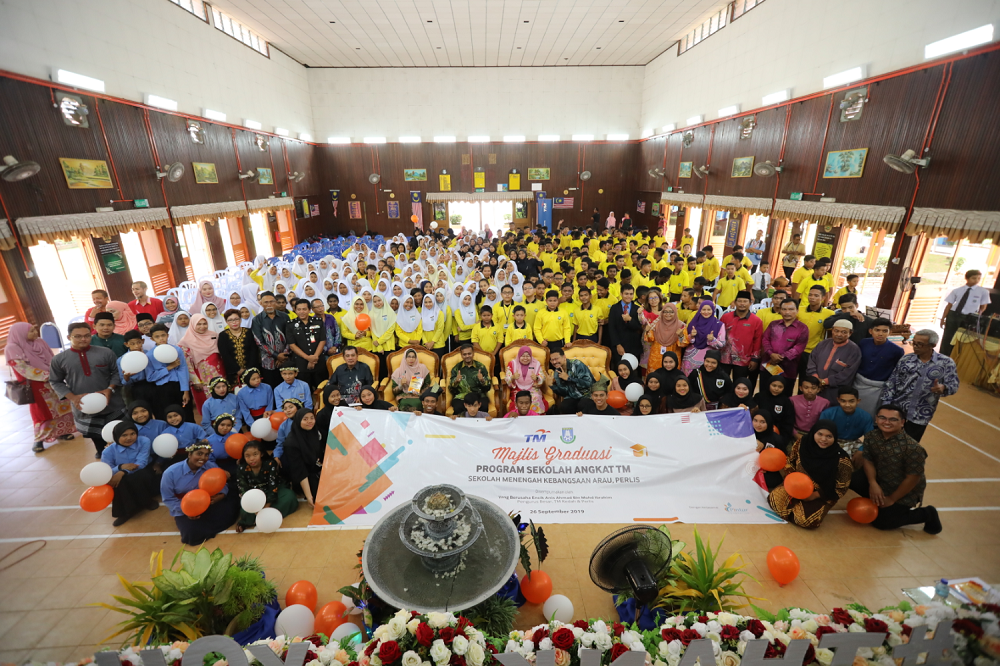
SMK Arau Graduates from TM adopted school programme
The Company also establishes a Robotics Hub at the school to encourage the students and surrounding communities to learn about innovation and technology Telekom Malaysia Berhad (TM), as a responsible corporate organisation mindful of its role towards nation building, today 'graduates' another adopted school under its TM School Adoption programme, Sekolah Menengah Kebangsaan Arau (SMK Arau) in Perlis. The closing ceremony which officially marked the end of the school's three (3) year adoption period, was officiated by Anis Ahmad Mohd Ibrahim, State General Manager, TM Kedah & Perlis. Also present at the closing ceremony were Tuan Haji Izmi Haji Ismail, Director of State Education of Perlis and Hajah Azizah Mustafa, Principal of SMK Arau. Speaking at the event, Anis said, "TM has adopted SMK Arau in August 2016, under the fifth phase of our TM School Adoption Programme in collaboration with our partner, PINTAR Foundation. Throughout the three (3) year adoption period, TM, with strong support from PINTAR Foundation as well as other partners including Creative Minds and Coachunity, organised numerous educational-based activities leveraging on its Science, Technology, Engineering and Mathematics (STEM)-related programmes such as robotics, 3D printing and data logging. These activities had certainly further enhanced the technologies and innovation knowledge in the teaching and learning process at the school. Besides that, one of the programmes, TM Coachunity has encouraged the students to be active in sports particularly rugby. We are indeed happy and glad to see that SMK Arau has benefitted from this School Adoption Programme, reflected in the school's improved performance, not only in the academic results, but also in co-curriculum activities, proving the programme has come to fruition." In terms of academic, SMK Arau has shown improvements and recorded encouraging accomplishments from year-to-year. Its School Average Grade or Gred Purata Sekolah (GPS) for Sijil Pelajaran Malaysia (SPM) has improved from 6.04 in 2016 to 5.47 in 2018. Throughout the 3-year adoption period, one (1) student from the school successfully obtained 9As, three (3) students obtained 8As, two (2) students achieved 7As, and three (3) students achieved 6As. Meanwhile, for Pentaksiran Tingkatan 3 (PT3), the school's GPS has improved from 3.94 in 2017 to 3.68 in 2018. A total of five (5) students achieved 10As, three (3) students achieved 9As, six (6) students obtained 8As, seven (7) students achieved 7As and nine (9) students got 6As in the PT3 examination throughout the period. Besides its commendable achievements in academic, SMK Arau also won numerous competitions at district, state and national levels especially in innovation and robotics, as well as sports and other co-curricular activities. "In addition, as part of the Company's contribution under Corporate Responsibility (CR) initiatives, TM has facilitated the establishment of a Robotics Hub at the school, complete with the necessary equipment and devices. We hope with the exposure to such technologies and innovations, we would be able to encourage the school's as well as the surrounding community members to adopt a more digital lifestyle, as we move towards a Digital Malaysia," added Anis. The TM School Adoption programme is aimed at improving the academic performances of the adopted schools and establishing a strong foundation for the nation's digital workforce in meeting future challenges, which include Industrial Revolution 4.0 (IR 4.0). Since its inception in 2003, the approach of the programme is continuously improved and it now offers a better learning experience for the school's community with the exposure to innovations and technologies through programmes such as TM Robotics Programme, 3D printing through TM 3Ducation Programme and pocket lab or data logging through TM Nano Maker Kit Programme. The programmes are designed to benefit not only the students and teachers, but also extended to the parents and the surrounding community. To date, TM has adopted 15 schools around Malaysia with two (2) active schools namely SMK Paya Rumput, Melaka and Sekolah Pendidikan Khas Pekan Tuaran, Sabah. Throughout the years, TM has allocated more than RM2.4 million for its school adoption programme. Thus far, the programme has touched more than 20,000 lives including students, teachers, parents and community members of the surrounding areas where the adopted schools are located. For more information on the Company's other Corporate Responsibility programmes, visit https://www.tm.com.my/sustainability
TM eases the burden of its adopted school
Zulkarnain Hassim, Assistant Manager, TM Miri (2nd from right), representing TM Sarawak handing over the mock cheque of the contribution to Raja Manikam, the Principal of SMK Medamit (2nd from left), flanked by Azizul Salfaizal Aziz, Assistant Manager, Corporate Responsibility, TM (left) and Dayang Rohani Bujang of TM Sarawak (right). Telekom Malaysia Berhad (TM) recently lent a helping hand to one of its adopted schools, Sekolah Menengah Kebangsaan (SMK) Medamit, Limbang, Sarawak with a cash contribution of RM13,000.00 to help rebuild the school’s administration building which was destroyed in a fire recently. Zulkarnain Hassim, Assistant Manager, TM Miri who represented Jafer Sadig Abdul Lathiff, State General Manager, TM Sarawak handed over the cash contribution to Raja Manikam, the Principal of SMK Medamit. Commenting on the initiative, Jafer Sadig said; “We hope this contribution will assist and alleviate some of the school’s burden to rebuild its administration building as well as to purchase the necessary office equipment, especially with the school’s new season has already begun. TM will continue to support and lend a helping hand to those in need in any way possible, including towards a nation-building cause through sustainable initiatives. Furthermore, SMK Medamit is one of the schools under TM Adopted School programme which is part of TM’s Corporate Responsibility initiative.” Meanwhile, members of the public can contribute to Tabung Bantuan Kebakaran SMK Medamit, which was launched via TM’s e-donation application called ‘Ensani’.
TM gets prepared ahead of the upcoming monsoon season with swift water safety and humanitarian response training
Training to Upskill TM Volunteers and GDRN Members Towards Disaster Preparedness Telekom Malaysia Berhad (TM) under its Corporate Responsibility (CR) initiatives once again provides a humanitarian response training for the Company’s volunteers as well as to members of the GLC Disaster Response Network (GDRN) ahead of the upcoming monsoon season. The Company recently organised the training session, titled “GDRN Swift Water Safety and Humanitarian Response” as part of its initiatives for disaster preparedness in Malaysia. The four-day training – which featured certified trainers and speakers from the National Disaster Management Agency (NADMA), Ministry of Defense and United Nations Humanitarian Response Depot (UNHRD) – was aimed at strengthening the participants’ humanitarian capabilities and minimising the loss of life and damage to properties and the environment during a disaster. The session saw participation of over 30 participants from TM, GDRN members from Axiata Berhad, Pharmaniaga, Malaysia Airport Holding Berhad (MAHB), Yayasan Hasanah and Yayasan Sime Darby. In addition, more than 30 volunteers from Volunteer Malaysia (VM) - formerly known as iM4U - also took part in the simulation exercise, under the coordination of Azura Ibrahim, a trainer from World Food Programme – UNHRD. Izad Ismail, Head of Corporate Responsibility & External Stakeholder Management, Group Brand and Communication, TM who attended the programme commented: “This training follows a series of previous successful training, from the Disaster Preparedness Training in 2015 and Humanitarian Logistics and Supply Chain Management Training in 2016. This year, we aim to continue providing the knowledge and skills essential for disaster preparedness and humanitarian response. This time around, the focus was on swift water safety. As we cannot predict where or when the next disaster will strike, we need to always be ready. Past experiences have taught us on the importance of working together in emergency response efforts in order to reduce and mitigate disaster risks and wastages. So the disaster scenario simulation exercise conducted during the training allows for a realistic response to potentially real disasters.” “This training also serves as a platform to integrate the functions and responsibilities within TM itself, GDRN members and relevant Government Agencies in leveraging resources effectively during disaster situations. We hope that this pro-active approach focusing on preparedness will help to improve the emergency response efforts if the actual situation occurs,” he added. The training provided the participants with an in-depth understanding of emergency relief works which include the standard operating procedures, logistics, fleet, supply chain and warehouse management as well as personal health, safety and security risks during disasters. Besides that, the participants were also exposed to Swift Water Swimming, Basic Swift Water Safety and Rescue and Basic Boat Paddling.

NEWSLETTER
Just drop your details and stay updated with the world of Telekom Malaysia. We promise – no spam!