OUR GOVERNANCE MODEL AND FRAMEWORK
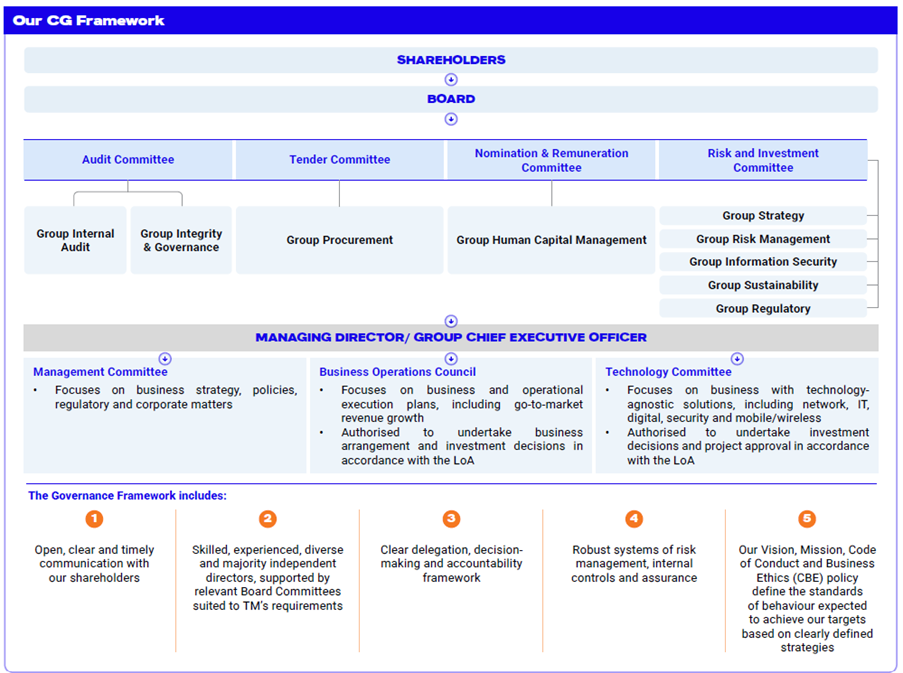
The CG Framework is supported by key governance instruments including the Board Charter, Limits of Authority (LoA) Matrix, Business Policy and Governance (BPG) and the Directors’ and Management’s Conflict of Interest (COI) Policy. The Board Charter is reviewed annually, while the LoA and BPG framework are updated in line with organisational transformation initiatives. This structured review process strengthens effectiveness, adaptability and regulatory compliance, while supporting timely identification of emerging risks, opportunities and evolving governance practices.
For comprehensive overview of TM’s application of MCCG’s practices, the Corporate Governance Overview Statement, to be read together with the Corporate Governance Report (CG Report) 2025, further elaborates how the practices of the MCCG are applied and any departure thereto. The CG Report is available on the Company’s website at tm.com.my.
KNOW MORE ABOUT OUR CORPORATE GOVERNANCE
IN-DEPTH INFORMATION
Corporate Governance Report
This report sets out how the Company observes the intended Outcomes as prescribed in the MCCG.
Directors’ Statement On Risk Management And Internal Control
This statement outlines the nature and scope of the risk management and internal risk control within TM’s Group during the financial year under review.
TM Board and Subsidiaries Remuneration Framework
This policy ensures that our remuneration is market competitive and equitable while aligning with our strategic thrusts and value drivers as well.
Top Senior Management Remuneration Framework
The Policy supports our vision and drives our business strategy to attract and maintain talent. It encompasses terms of employment, reward structure, fringe benefits and pivotal positions.
Guide for Excellence in Corporate Governance
A compilation of the terms of references of our Board and Board Committees, practices, principles and codes as a primary source of reference on our governance policies.
TM Code of Conduct and Business Ethics
This Code provides guidance in resolving any business, legal and ethical issues that one may encounter when conducting business, as well as the standards of behaviour expected of all those in upper management.
The Companies Act 2016
As a public company limited by shares, enclosed is Telekom Malaysia’s Constitution and every statutory modification or re-enactment made since first being in force, including subsidiary legislation too.
TM BOARD RECOGNISES THE IMPORTANCE OF ADDRESSING CONFLICTS WITHIN THE BOARD SENSIBLY, FAIRLY AND EFFICIENTLY WITHIN THE COMPANY, IRRESPECTIVE OF THE PARTIES INVOLVED.
The Chairman and Senior Independent Director (SID) have a tacit role to act as the intermediary to resolve any issue or sensitive matter that arises between members of the Board. In instances of conflict or issues between Board members and employees involving unethical conduct of any member of the Board, TM has established a grievance procedure whereby aggrieved employees may escalate complaints against the Board member via a formal channel through the SID and/or the Company Secretary.
The SID and/or Company Secretary will evaluate and, if required, stream the complaint to the NRC Chairman for consultation to decide on the next course of action. If the complaint is substantiated and warrants further investigation, an independent ad hoc Board Ethics Committee will be established to review and investigate the complaint and recommend the next course of action to the NRC. Ultimately, TM Board will decide on the most appropriate action to be taken against the Director.